Professional Tasting Training in Ubud
Learn Professional Coffee Evaluation from a Q-Grader Expert
Master the art of coffee tasting: explore aroma, flavor, acidity, body, and aftertaste across 12 Indonesian specialty coffees
Book via WhatsApp
Reserve Your Spot
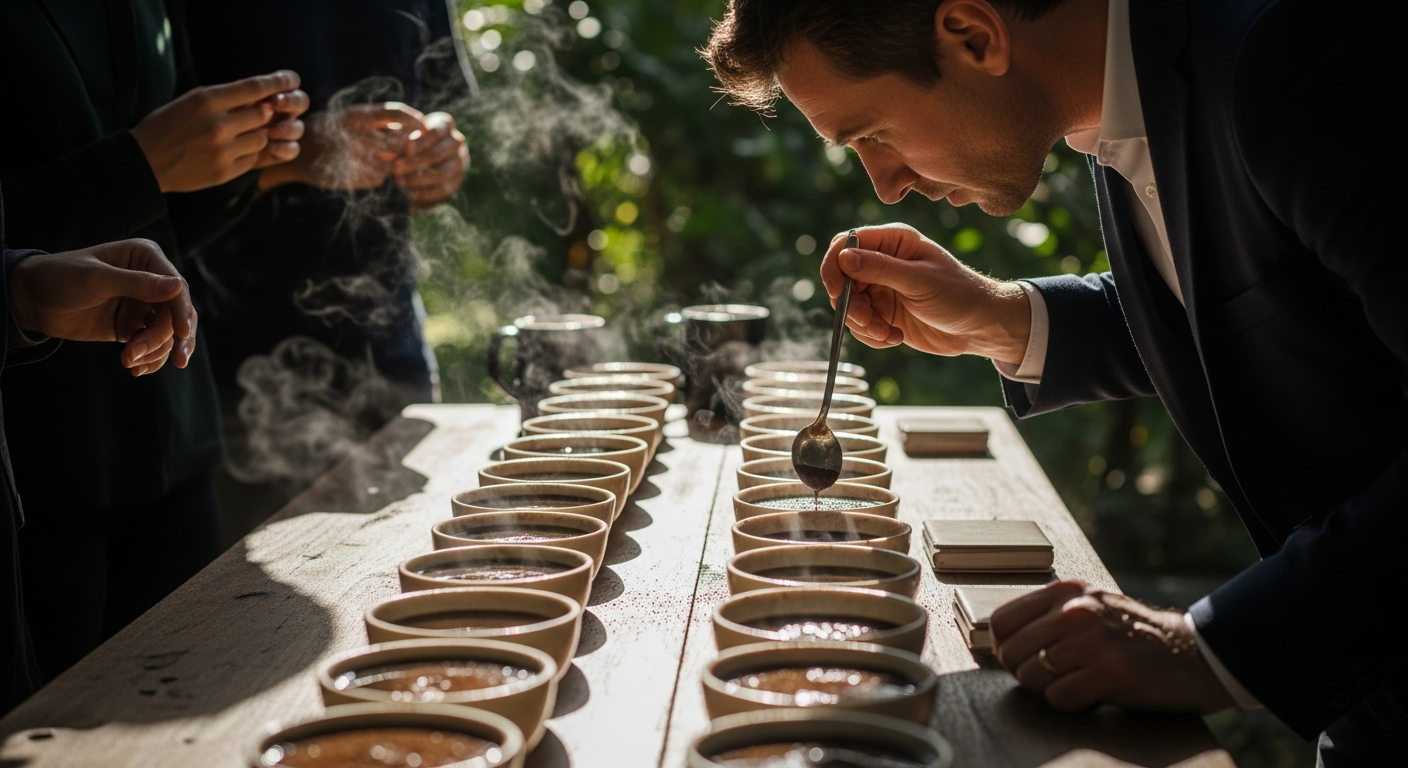
Whether you’re a coffee enthusiast seeking deeper knowledge or a barista wanting professional credentials, our Coffee Cupping Masterclass offers intensive training in specialty coffee evaluation. Led by an SCA-certified Q-grader (professional coffee taster), this 2.5-hour session teaches the standardized cupping methodology used in international coffee competitions and quality assurance worldwide.
This isn’t a casual tasting tour. You’ll learn the same evaluation techniques used by coffee importers, roasters, and competition judges. You’ll develop your palate systematically, learn to identify flavor compounds with precision, and understand the science behind what makes specialty coffee special.
Most coffee experiences ask you to sip and guess. Our masterclass teaches you the framework for accurate evaluation. You’ll learn to decompose coffee flavor into measurable categories (aroma, flavor, acidity, body, aftertaste), use standardized vocabulary to describe what you’re tasting, and understand the science of why certain coffees taste certain ways.
By the end of the session, you’ll possess concrete tasting skills applicable to any coffee. You won’t just know that Kopi Luwak tastes “special”—you’ll understand exactly why, and be able to evaluate any specialty coffee with similar precision.
Learn to identify subtle aromas from first sniff. Discover how aromas indicate roast level, bean origin, and processing method. Practice distinguishing between floral, fruity, spicy, and earthy notes.
Understand flavor compounds released during brewing. Learn to identify primary flavors (chocolate, fruit, nuts), secondary flavors (caramel, honey), and tertiary flavors (tobacco, leather). Taste the same coffee across 12+ varieties to develop comparative understanding.
Discover that “acidity” in specialty coffee is positive—it means brightness and liveliness. Learn to evaluate acidity on scales from flat to extremely vibrant. Understand how origin and processing affect acidity levels.
Assess coffee’s mouthfeel and weight on the palate. Learn why some coffees feel light and tea-like while others feel heavy and syrupy. Understand how processing and roast level influence body.
Evaluate the finish—how flavors linger after swallowing. Learn to identify clean vs. muddy aftertastes, long vs. short finishes, and how quality coffees maintain flavor clarity through the finish.
Master the standardized SCA cupping protocol. Learn proper water temperature (195-205°F), coffee-to-water ratios, grind size, timing, and evaluation sequence. This methodology is used internationally for consistency.
Learn to use the Specialty Coffee Association Flavor Wheel—the visual tool coffee professionals use to precisely describe tastes. Move from vague “good flavor” to specific descriptors like “honeyed sweetness with cocoa undertones.”
Taste coffees from different Indonesian regions side-by-side. Learn how altitude, soil, processing, and climate create distinctive flavor profiles. Discover why Ethiopian coffees taste different from Sumatran coffees.
The legendary fermented coffee—understand why civet digestion creates such distinctive smoothness
Premium highland coffee from volcanic soil—bright acidity and floral notes
Full-bodied coffee with earthy character from wet-hulled processing
Historic coffee variety with spicy, herbal notes
Lesser-known origin with fruit-forward, tea-like characteristics
Understanding Robusta varieties—their role in blends and espresso
Full-bodied with exotic spice and herbal complexity
Single-bean variety with concentrated, intense flavors
Learn how processing method dramatically affects taste
Compare the same origin, different processing—understand the methodology’s impact
Experience origin characteristics highlighted by light roasting
Compare roast level impact on the same coffee
Your Q-grader instructor explains cupping methodology, the Specialty Coffee Association standards, and how professional tasters evaluate coffee. Learn the vocabulary you’ll use throughout the session—aroma, flavor, aftertaste, body, acidity.
Examine 12 coffee samples’ dry aroma (before water is added). Your guide points out subtle differences between origins. Practice identifying floral vs. fruity vs. earthy aromas. You’ll start recognizing patterns like “African coffees tend toward fruity aromas” and “Sumatran coffees lean toward earthy.”
Water is added to all samples at precisely 200°F. You’ll learn proper technique for breaking the “crust” (floating grounds) and sampling. Your guide explains the standardized SCA methodology—why water temperature matters, why timing matters, why consistency matters.
The main tasting session. You’ll systematically evaluate each coffee for flavor notes, acidity (brightness on your palate), and body (mouthfeel weight). Your guide offers guidance: “Notice how this Ethiopian feels lighter on your tongue? That’s characteristic acidity. Compare it to this Sumatran—feel the difference?” You’ll record observations on your cupping sheet using precise terminology.
Evaluate how flavors linger after swallowing. Learn why some coffees have clean finishes while others taste muddy. Understand how fermentation, processing, and roast level affect the finish. Compare the cleanliness of a lightly roasted coffee vs. a dark roast.
Step back and compare all 12 samples side-by-side. Your guide leads discussion: “Why does the Kopi Luwak feel smoother than other coffees? What’s happening chemically?” Learn about fermentation effects, processing impacts, and roast chemistry. Understand flavor profiles scientifically, not mystically.
Receive your cupping certificate acknowledging completion of professional training. Discussion of how to continue developing your palate at home. Opportunity to ask detailed questions about specific coffees or flavor science.
| Session Type | Group Size | Price Per Person | Duration |
|---|---|---|---|
| Standard Group Masterclass | 2-8 people | $69 USD | 2.5 hours |
| Individual Registration | 1 person joining group | $79 USD | 2.5 hours |
| Private Masterclass | Up to 4 people | $299 USD (group rate) | 2.5 hours |
| Extended Masterclass | 2-8 people | $99 USD | 4 hours |
The extended session adds an extra 1.5 hours, allowing for:
You already enjoy coffee and want to understand what you’re tasting. This masterclass teaches you the professional framework for evaluation, transforming casual appreciation into informed expertise. You’ll never enjoy coffee the same way again—in the best possible way.
Whether you’re preparing for SCA cupping certification exams or simply wanting to improve your professional palate, our Q-grader instructor offers training aligned with international standards. Many professional baristas use this masterclass as foundation for further certification study.
If you work in coffee retail, this training helps you advise customers with authority. You’ll understand your products deeply and can explain flavor profiles to customers rather than simply restating tasting notes on bags.
Anyone involved in coffee purchasing or quality control benefits from professional cupping training. Many international coffee traders and roasters have staff participate in our masterclass.
Even if you have no coffee background, this masterclass is accessible and fascinating. Many participants say it’s one of their favorite vacation activities—you develop actual skills, not just collect memories.
Our lead instructor holds SCA Q-Grader certification through the Specialty Coffee Association. This credential requires:
Q-graders are qualified to judge international coffee competitions, evaluate lots for importers and roasters, and train other coffee professionals. When you learn from a Q-grader, you’re learning from someone who has demonstrated expertise at the highest professional level.
Develop professional tasting skills and earn your completion certificate. Sessions available daily—register now to secure your spot.
Book via WhatsAppSessions at 10:00 AM and 2:00 PM daily
WhatsApp: +62 812 345 67890
You will learn professional SCA-standard cupping techniques including fragrance evaluation, slurping methodology, flavor wheel identification, scoring sheets, and how to distinguish between different processing methods and origins. The session features 6-8 premium coffees including wild Kopi Luwak.
No prior experience required. Our masterclass is designed for both beginners and enthusiasts. Expert Q-graders guide you through each step, from basic aroma recognition to advanced palate calibration, ensuring everyone gains valuable tasting skills.
Our masterclass accommodates 2-12 participants per session for an intimate learning experience. Private sessions for couples or small groups can be arranged, and corporate team-building packages for up to 20 people are available upon request.
The fee includes all tasting materials, a cupping kit to take home, a certificate of completion, light refreshments, and a 50g sample of wild Kopi Luwak. Premium masterclass upgrades include a full coffee brewing equipment set and expanded tasting flight.
The standard masterclass runs 2-3 hours, covering theory, practical cupping of 6-8 coffees, Q&A with our expert roaster, and a guided comparison tasting. The premium extended masterclass is 4 hours and includes roasting demonstration.
Whether you seek the world's finest coffee or an unforgettable Balinese experience, we guide you through authenticity.