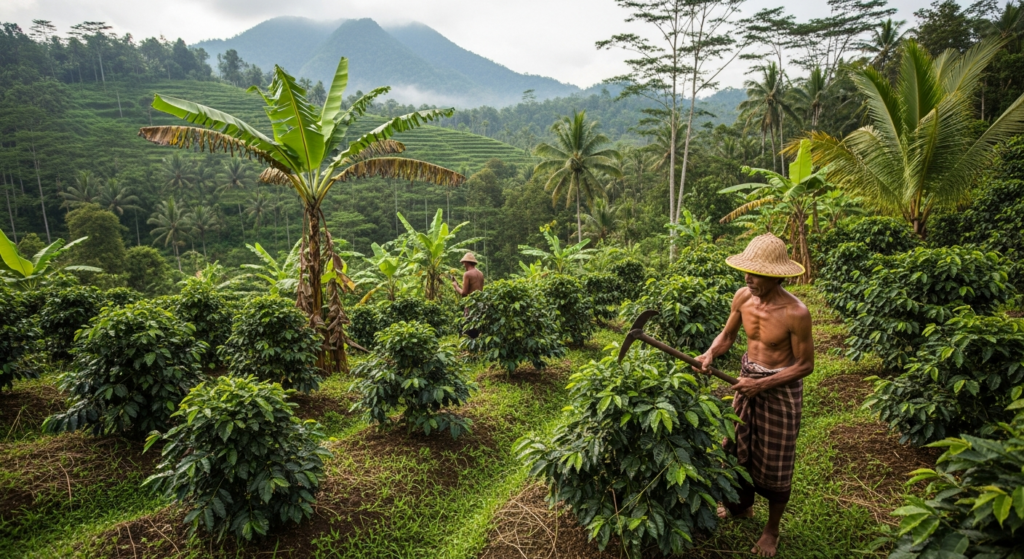
Meet the dedicated farmers preserving Bali’s ecosystems while cultivating world-class coffee. Learn how supporting small-scale sustainable agriculture creates lasting positive impact.
Bali’s Coffee Heritage and Modern Challenges
Bali’s coffee-growing regions—particularly Kintamani and West Bali—have cultivated coffee for generations. These volcanic slopes create ideal growing conditions, but modern agricultural pressures threaten both farming viability and environmental health. Industrial-scale farming practices have pressured small farmers to abandon traditional methods in favor of chemical-intensive monoculture.
Yet a growing movement of committed small farmers is reversing this trend. At balikopiluwak.com, we partner exclusively with these visionary farmers who prove that profit and environmental stewardship aren’t opposing forces—they’re interdependent.
The Bali Situation: Over 30,000 hectares currently cultivated for coffee, but small farms declining as farmers migrate to urban centers or convert land to development. Supporting sustainable small-farm coffee directly prevents land conversion and preserves agricultural livelihoods.
What Makes Coffee “Sustainable”?
Sustainability in coffee encompasses three interconnected dimensions:
Environmental Sustainability
- Biodiversity preservation through agroforestry practices that maintain native species habitats
- Water conservation via efficient irrigation systems and watershed protection
- Soil health maintained through organic amendments and rotation practices
- Zero synthetic chemicals protecting soil microbiomes and groundwater
- Carbon sequestration through shade-grown coffee and reforestation efforts
- Waste reduction and composting of coffee cherry pulp
Economic Sustainability
- Fair prices that exceed commodity benchmarks, ensuring farmer profitability
- Stable income through long-term buyer relationships and contracts
- Reduced input costs from organic practices eliminating chemical purchases
- Premium market access for specialty and certified coffee
- Community reinvestment where portion of profits support local infrastructure
Social Sustainability
- Fair labor practices with safe working conditions and family-friendly hours
- Community respect and indigenous knowledge preservation
- Youth retention through economic viability that prevents rural migration
- Knowledge transfer from older farmers to younger generations
- Women’s empowerment with equal opportunities in all farming roles
- Community services from profits supporting schools, healthcare, and infrastructure
Bali’s Leading Sustainable Practices
Shade-Grown Coffee Agroforestry
Rather than clearing forests for coffee monoculture, Balinese farmers maintain complex shade structures that mimic natural forest canopies. These systems include:
- Native shade trees providing habitat for birds, insects, and mammals
- Fruit trees (mango, banana, cacao) providing dietary diversity and additional income
- Nitrogen-fixing plants naturally fertilizing soil
- Water infiltration maintained through organic matter and reduced runoff
- Microclimate moderation reducing temperature extremes and water stress
Studies show shade-grown coffee farms in Bali harbor 50-70% more bird species than conventional monocultures. These systems sequester 1.5-3 tons of carbon annually while maintaining coffee yields.
Organic Certification and Chemical-Free Farming
Leading Balinese farms transition to certified organic methods, eliminating:
- Synthetic pesticides and fungicides
- Chemical fertilizers
- Herbicides and desiccants
Replacement practices include:
- Companion planting with pest-repelling native species
- Manual pest management and integrated pest management (IPM)
- Compost and manure replacing chemical fertilizers
- Beneficial insect populations controlled through predator-prey relationships
The transition period (typically 3 years) requires patience and commitment, but yields long-term soil improvement and production increases. Certification bodies provide transition support and market premiums.
Water Management and Watershed Protection
Bali’s volcanic terrain creates watersheds supplying drinking water to millions. Sustainable coffee farmers implement:
- Rainwater harvesting for irrigation and household use
- Spring protection preventing contamination and maintaining flow
- Terraced gardens reducing erosion and maximizing water infiltration
- Reduced water extraction maintaining groundwater levels
- Wastewater treatment preventing agricultural runoff pollution
Research shows farms implementing these practices improve water quality measurably within 5 years, directly benefiting communities downstream.
Soil Regeneration Through Organic Practices
Sustainable farmers view soil as living ecosystem, not inert medium. Regenerative practices include:
- Composting systems returning organic matter to soil
- Mulching protecting soil structure and moisture
- Cover crops preventing erosion and fixing nitrogen
- Crop rotation reducing pest cycles and nutrient depletion
- Minimal tillage preserving soil biology and structure
- Regular soil testing monitoring biological and chemical health
Regenerative Bali farms show organic matter increases from 2-3% to 4-6% within 10 years, dramatically improving water retention and fertility.
Community Impact: How Sustainable Coffee Supports Bali
Economic Opportunity for Small Farmers
Balinese coffee-growing regions include some of Bali’s poorest communities. Sustainable coffee practices create economic viability that prevents rural collapse:
- Fair prices: Sustainable coffee commands $3-4/kg vs. commodity rates of $1.50-2/kg
- Reduced input costs: Organic farming reduces expenses by 40-50% compared to chemical systems
- Premium market access: Certification enables direct relationships with international buyers
- Diversified income: Shade trees provide fruit and other products for additional revenue
Youth Retention and Knowledge Preservation
When farming becomes economically viable and respected, younger generations remain engaged. Sustainable coffee systems support:
- Career continuity: Children choosing to remain farmers rather than migrate to cities
- Traditional knowledge integration: Indigenous practices combined with modern sustainability
- Education investment: Profitable farming enables school attendance and higher education
- Community cohesion: Family farms maintaining traditional social structures
Women’s Economic Empowerment
Coffee farming traditionally excluded women from decision-making. Sustainable systems intentionally include women as:
- Farm managers and land owners
- Cooperative leaders and business operators
- Agronomy specialists and trainers
- Processing and value-addition entrepreneurs
Women’s engagement strengthens community resilience and household food security.
Environmental Impact: Protecting Bali’s Ecosystems
Biodiversity Preservation
Shade-grown sustainable coffee farms function as wildlife corridors and habitat refuges. Research in Bali coffee regions documents:
- Bird species: 120+ species documented on shade-grown farms vs. 15-20 on monocultures
- Insect diversity: 40+ native pollinator species maintaining agricultural productivity
- Small mammals: Palm civet populations (the source of Kopi Luwak) thriving on well-managed farms
- Soil microorganisms: Beneficial fungi and bacteria supporting plant health
Climate Change Mitigation
Sustainable Bali coffee farms contribute meaningfully to climate goals:
- Carbon sequestration: Shade trees and soil organic matter sequester 2-5 tons CO2/hectare annually
- Reduced emissions: Elimination of chemical production and transportation saves 0.5-1 ton CO2/hectare
- Watershed integrity: Maintained forests prevent water-crisis adaptation costs
- Agricultural resilience: Diversified farms better withstand drought and extreme weather
Supporting Bali’s Sustainable Coffee Movement
When you purchase sustainable Kopi Luwak from our ethically-sourced collection, you directly support these transformational farmers. Every purchase:
- Pays fair prices that exceed commodity benchmarks by 100-200%
- Funds certification for organic and Fair Trade verification
- Enables investment in soil regeneration and water systems
- Supports education for farmers’ children
- Preserves ecosystems that protect Bali’s water supply and biodiversity
Your Coffee Matters. Explore our sustainable Kopi Luwak selection and meet the farmers behind your morning cup. Visit our Bali coffee guide for farmer profiles and stories. Contact us at wa.me/6281139414563 to learn more about our farmer partnerships.
Explore More
• Ethical Kopi Luwak Collection — Responsibly sourced premium beans
• Our Ethical Standards — Learn our commitment to sustainability
• Know Your Kopi Luwak — Understand origins and certifications
Frequently Asked Questions
What is Kopi Luwak and where does it come from?
Kopi Luwak is the world's rarest coffee, produced from beans naturally processed by wild Asian palm civets in Indonesian tropical forests. Bali, Sumatra, and Java are the primary production regions, with Balinese Kopi Luwak considered among the finest.
Is Kopi Luwak worth the price?
For coffee connoisseurs, wild Kopi Luwak offers a genuinely unique tasting experience that cannot be replicated by any other processing method. The combination of natural civet selection, enzymatic fermentation, and extreme rarity creates exceptional value for those seeking the world's finest coffee.
How can I buy authentic Kopi Luwak online?
Purchase from reputable producers who offer full traceability, certificates of authenticity, and transparent sourcing information. Bali Kopi Luwak ships worldwide with complete documentation. Browse our shop for premium wild Kopi Luwak in various formats.
Can I visit a Kopi Luwak plantation in Bali?
Yes, Bali Kopi Luwak offers guided plantation tours in Ubud and Kintamani with professional cupping sessions. Tours include hotel pickup, plantation walk, processing demonstration, tasting, and optional purchases at origin prices.
What is the best way to brew Kopi Luwak at home?
For the best results, use a pour-over or French press method with freshly ground beans, water at 92-96°C, and a 1:15 coffee-to-water ratio. Medium grind produces the most balanced extraction of Kopi Luwak's delicate chocolate-caramel flavor notes.